Selo DNV Type Approved ProductCertified by
DNV classification
CRANKPIN TEMPERATURE MONITORING

A new layer of protection for your engine.

Talk to a Specialist

CTM detects abnormal heating of crankpins and big-end bearings and acts before catastrophic failure.

How it works

From the sensor at the crankcase inspection door to a safe shutdown with real-time monitoring, historical database and event log.

DNV CERTIFICATION
Selo DNV Type Approved ProductDNV Type Approved Product
Approved by DNV

Approved by the world's leading classification society for ALL engines.

COMPARISON

CTM vs OMD

The OMD only acts once oil mist has already formed. CTM detects bearing heating and shuts down much earlier, while damage can still be avoided.
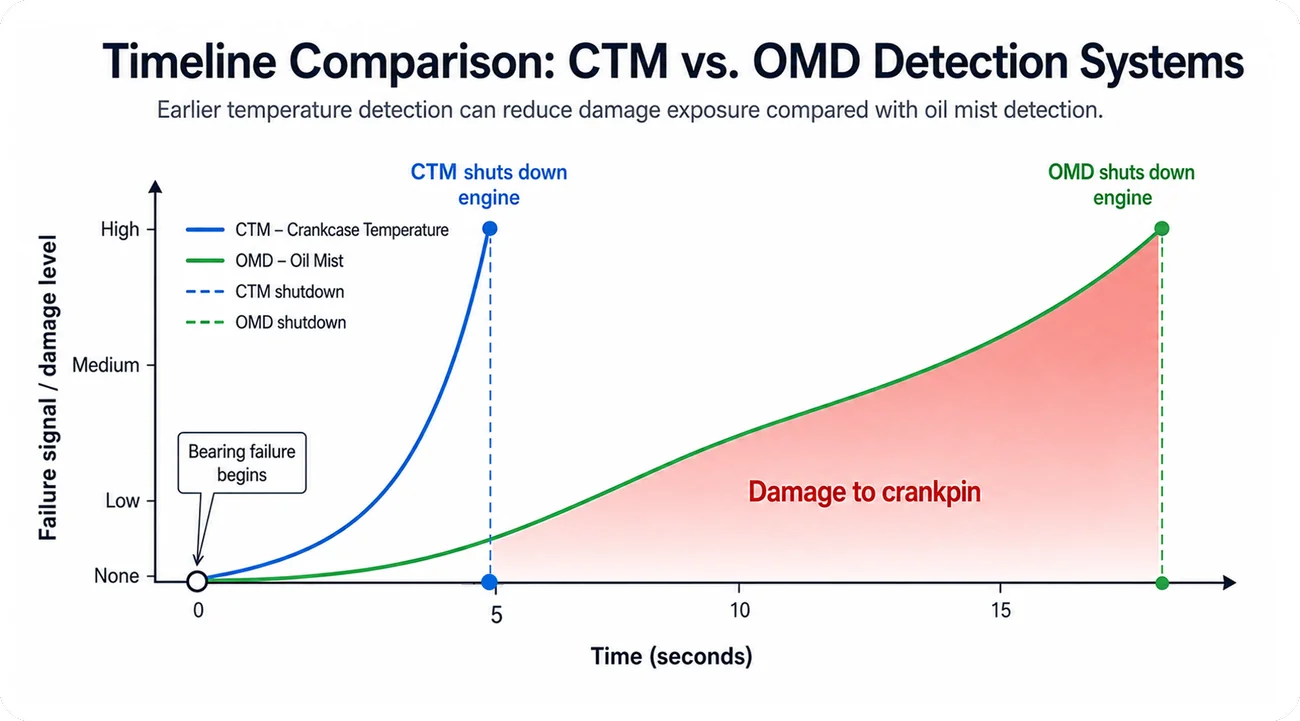
CTM vs OMD, comparação de tempo de detecção

CTM differentials vs. Other Oil-Splash Systems

Selo DNV Type Approved ProductStandardized protection for any engine in the fleet
02
10× more readings than the benchmark
03
Latest-generation hardware
04
Negative temperature deviation reading

+ More readings, earlier detection and OEM-independent protection

COMPARISON

CTM versus conventional systems

CapabilityOMD (oil mist detector)Other oil-splash systemsCTM · AIX
Detects bearing heating (root cause)NoPartial✓ Yes
Acts before oil mist formsNoNo✓ Yes
Readings per second1/s1/s10/s
Typical time to shutdown~18sVaries~5s
Per-cylinder monitoring (Delta T)NoNo✓ Yes
Non-invasive installation (inspection door)NoNo✓ Yes
Historical database and event logLimitedNo✓ Yes
Coverage for engines of all manufacturersVariesVaries✓ Yes
International certificationVariesVariesDNV DNV
Reacts to mistPartial coverage✓ Anticipates failure

Installation & Commissioning

1

Survey

2

Laboratory

3

Lab testing

4

On-board installation

5

On-board testing

6

Commissioning

1
Step 1On-board installation
2
Step 2Commissioning tests

Applications

For critical engines in environments that cannot afford unplanned downtime.

Selo DNV Type Approved ProductDNV-approved for engines from 6 to 20 cylinders, of all manufacturers
FREQUENTLY ASKED QUESTIONS

Frequently asked questions

How is the CTM installed on the engine?
The sensor is installed at the crankcase's existing inspection door, with no structural changes to the engine.
How many readings per second does the CTM take?
10 readings per second per measurement point, 10 times more than the market standard of 1 reading per second.
Does the CTM work on engines from any manufacturer?
Yes. The CTM has DNV Type Approval for engines from 6 to 20 cylinders, of all manufacturers.
What's the difference between the CTM and the OMD (oil mist detector)?
The OMD reacts after oil mist has already formed. The CTM detects bearing heating before that, at the root cause, and shuts down the engine safely in about 5 seconds, as soon as it identifies the temperature deviation at the crankpin and before catastrophic failure, versus about 18 seconds for the OMD, time in which bearing damage may already be advanced.
What happens when the CTM detects an anomaly?
The engine is shut down automatically and safely, and the event is logged in the system's historical database and event log.
What technology does the CTM use?
Latest-generation hardware, with per-cylinder monitoring and high-speed industrial communication.

Ready to add a new layer of protection to your engine?

Talk to us about CTM

Tell us the engine and the application. Our technical team replies with scope, installation and quote.

Prefer another channel?